A day in the life of…

A day in the life of…

If anyone had told me a year ago, 27. November 2017, that I would start writing blog posts I would have laughed my head off and probably hysterically. Hysterically because, writing blog posts are not fun, or so I thought then (- still not sure), and hysterical because of the thought “who the heck is interested in what I have to say anyway”.

And actually a year ago I was enjoying Ayurveda treatments in Sri Lanka… (maybe a blog post for another day 😉  – had no intention of blogging and no idea that I would be looking for a coach…

Well, here we go. This might not be my first blog post, it’s my third, but the direction where this is going is different.


To blog or not to blog

So, for me to learn the ins and outs of blogging, I’m doing a blog crash course with Judith “Sympatexter” Peters. Judith is hilarious, as in a VERY good way. She knows how to tell stories that keep one engaged till the end. I’m aspiring to be like her.

What happened to the other blog posts? Not believing in myself enough to write them, which in hindsight is probably rubbish, well, (hides face in shame – not really HAHA) I bought them. Better said, I had someone finish them up for me (and paid them). Amazing what you can buy on the internet…

The posts were not about me and what i do but more like an overview of the methods that I “practice”. Practice is also not a good explanation because that would mean I don’t really know what I’m doing or not experienced. So let’s try and define this a little better – practice as in perform or carry out or administrate. Sounds quite profound, what… Thank goodness for the internet, AGAIN.

They’re still there if you want to go and compare… here and here.

Working in/on the practice

Insights on short sightedness – is that a word???

Next on the agenda for today is picking up my new glasses. I’m short sighted… well have become with age… An interesting concept. Not the age part, the other one.

According to dictionary.com short sightedness also means “lacking imagination or foresight”.

Heck! I am definitely not lacking in imagination – as for foresight – again dictionary.com comes to help:  “the ability to predict what will happen or be needed in the future.”

So to the foresight (Imagination’s been covered) – I’m not a fortune teller (or “future” teller) BUT i do have help in getting done what needs to get done. I’m part of a coaching called SOMBA – Sigrun’s online MBA. This has practically saved my life. Well kinda. If it weren’t for the course and the community I would probably still be hiding behind my laptop and not about to share with the world what I’m up to. Pretty scary thought…

Sigrun is so inspiring. Her motto is: Be inspired, Think big and Take Action.

And my masterminding buddies are the best!


I’m not an affilliate – in case you were wondering

Taking action after thinking big and being inspired

Sooooo me being inspired, thinking big and taking action agreed to do an article for a health guide that will be published in Canton Zurich for a year and placed in doctor’s offices, pharmacies, local municipalities and who knows where else – everywhere…

This is how the publishing company describes it: “The “health guide for the whole family” is a competent guide for people of all ages and reports up-to-date and informative from the areas: Health & nutrition, Therapies & Healing Methods, Fitness & Exercise, Wellness & Beauty and Tax & Law.”

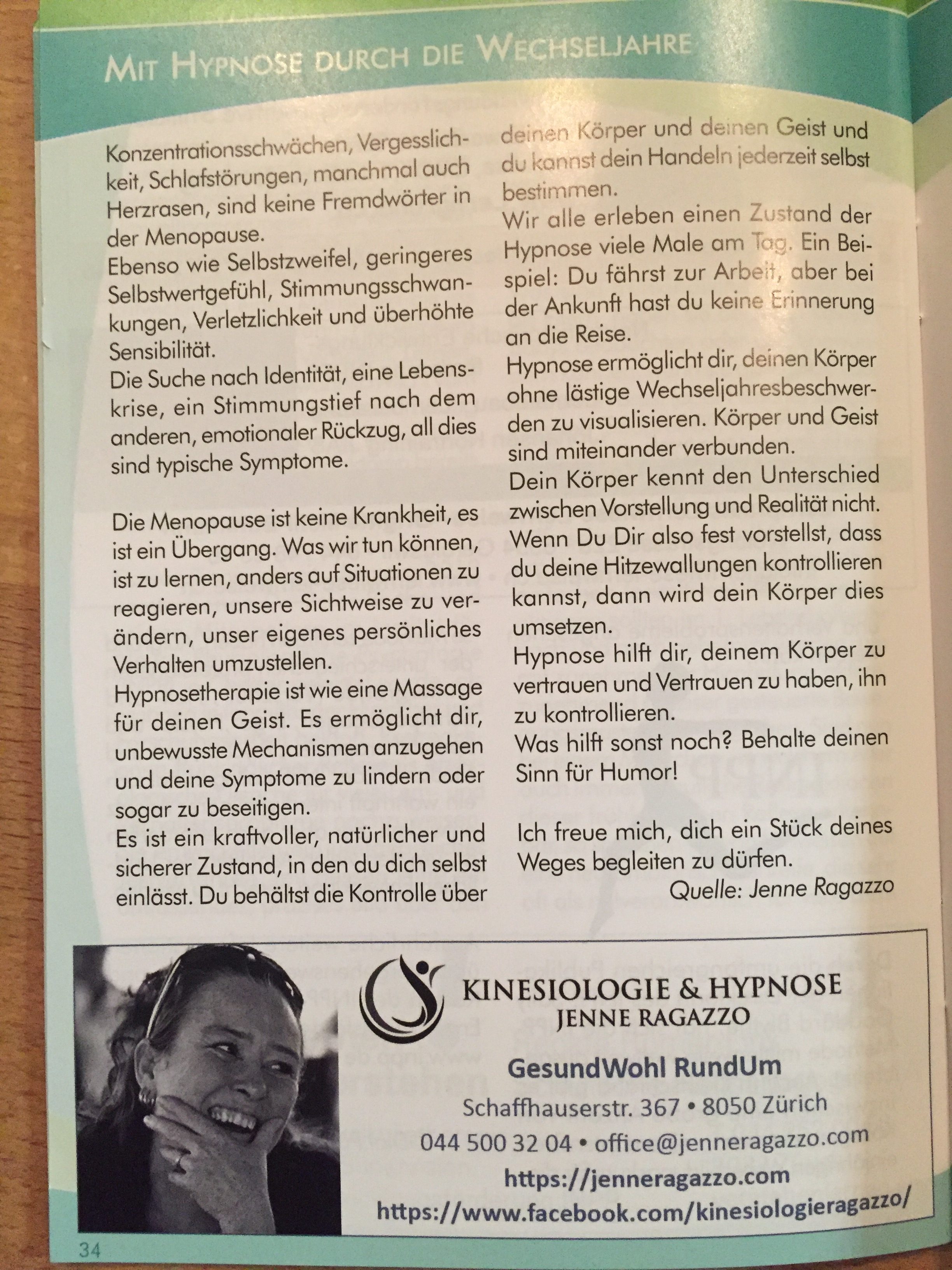
My contribution is on Hypnosis during Menopause.. And mid life. What we women experience, what hypnosis is (not too much detail – there wasn’t enough space in the article…) and how it can help with climacteric syndrome.

For my german speaking friends to find out more hop on over here.

Gesundheitsratgeber – LDK Verlag

So there we have it. Survived the task at hand of blogging and am looking forward to doing more in the future.

And apparently I like starting sentences with “SO” and love using dotdotdot’s…….
Menopause – Gastbeitrag von Katharina Wissmann

Menopause – Gastbeitrag von Katharina Wissmann

Wechseljahre, Klimakterium oder Abänderung, es gibt viele Begriffe für den Zeitraum vor und nach der letzten Regelblutung einer Frau.

Beginnen wir bei der Einweihung

Es heisst, dass die matriarchalischen Kulturen des frühgeschichtlichen Indiens, Ägyptens und des mittleren Ostens bei Ihren Einweihungszeremonien Henna oder andere rote Pigmente benutzt haben mit denen die Füsse junger Mädchen auf der Schwelle zur Erwachsenenwelt rotgefärbt wurden.

Die rote Farbe symbolisierte das Blut der ersten Menstruation und damit die Fähigkeit der jungen Frau, neues Leben zu empfangen und auszutragen. Die Zeremonie feierte die weitreichende Bedeutung der weiblichen Blutungen in all ihren Ausdrucksformen, das Blut der Menstruation, der Geburt und Fehlgeburt fliesst den Füssen der Frau, die dieses Reifestadium erlangt hat, entgegen.

Quellenangabe: Die Wolfsfrau Clarissa Pinkola Estés Seiten 285/286

Die Weigerung sich dem Zyklus von Werden, Vergehen und Neuwerden zu stellen


Ich befasste mich schon einige Zeit vor den Wechseljahren mit meiner Abänderung. Mein Wunsch war es diesen Übergang harmonisch zu gestalten und bewusst zu leben. Dafür zog ich eine Kinesiologin hinzu.

Von Frauen, die diese Phase bereits gemeistert hatten, wurde ich mit vielen Ängsten und Unwissen konfrontiert.

Eine Frau fühlte sich nicht mehr attraktiv. Sie hatte sich eben neu verliebt und viele diffuse Ängste. Eine Andere hatte heftige Schweissausbrüche und Hitzewallungen. Weil sie das nicht wollte nahm sie Hormone.
Eine Kollegin litt unter enormen Stimmungsschwankungen und war immer wieder in Trauerphasen.

Wiederum von einigen Frauen hörte ich, dass sie endlich froh waren den monatlichen Zyklus hinter sich zu haben. Teilweise weil er mit viel Schmerz verbunden war, einige fanden ihn lästig, für nicht wenige war er mit viel Ekel verbunden.


Wie wird dieses Vergehen und Neuwerden für mich sein?

Durch ihren Körper sind Frauen von Natur aus schon sehr eng mit der zyklischen Wesensnatur verbunden. Man kann sagen, dass Frauen das Wissen der Skelettfrau jeden Monat mit ihrem Monatszyklus zu erkennen geben und insofern von Natur aus Instrumente der Leben/ Tod/ Leben-Natur sind.

Jede Frau mit einigermassen ausgeprägten Instinkten weiss, dass sie im Lauf jeden Monats physisch, emotional und spirituell einen Höhepunkt erklimmt und auf einen Tiefpunkt sinkt und dass dieser Zyklus nur ein sehr untergeordneter innerhalb von unendlich viel grösseren, umfassenderen Zyklen in ihrem Dasein ist.

Quellenangabe: Die Wolfsfrau Clarissa Pinkola Estés Seite 190

Eines war von allem Anfang an klar. Hormone und andere Medikamente kamen für mich nicht in Frage. Ich bin tief verbunden mit meinem Körper, nehme ihn gut wahr und wollte den Übergang bewusst erleben. Den Wechsel von der Frau zur Frau. Ich möchte mich nicht darauf reduzieren, die Zeit wo ich Kinder haben konnte und die Zeit danach. Auch ohne monatlichen Zyklus fühle ich mich attraktiv und fraulich.

Vor ungefähr 10 Jahren war dann der Tag x da. Ich spürte eine Veränderung im Zyklus. Der Fluss war stärker und intensiv. Teilweise erlebte ich ihn als nie enden wollenden Strom. Auch waren Blutklumpen dabei die teilweise heftig aus mir drängten. In all dem spürte ich etwas reinigendes und erleichterndes. Es fühlte sich so an, dass all die Themen, die sich in meinem Unterlaib angesammelt hatten gereinigt wurden.

Ein Schamane bringt diese Blutfetzen mit gespeicherter Wut in Verbindung. So betrachtet konnte sich einiges lösen. In meine Biografie passte das voll und ganz. Sicherlich hatte sich in meinem weiblichen Becken viel Wut angesammelt, tiefe, lange zurückliegende Spuren von Grenzüberschreitungen und Missbrauch.

Dieses loslösen dauerte manchmal mehre Wochen und war für mich grundsätzlich ein angenehmer Prozess. Was sich allerdings irgendwann bemerkbar machte, war eine gewisse körperliche Schwäche und eine Kraftlosigkeit. Der Blutverlust machte sich bemerkbar. Ich fühlte mich schlapp, müde und energielos.
Beunruhigt hat mich das nie. Ich empfand den Verlauf des Übergang sehr erlösend und reinigend.


Symptome

Als einziges verlor ich ganz viele Haare. Dies war eine gewisse Zeit ein grosser Stress, da ich bemerkte, dass ich etwa nur noch die Hälfte meiner Haare hatte. Ich liebte die rote Mähne über alles und wollte sie weiterhin geniessen. Abhilfe leistete eine Ernährungsanpassung. Ich kochte morgens Hirse und allmählich kam meine Haarpracht zurück.

Hitzewallungen

Hitzewallungen sind häufig das erste Zeichen der Wechseljahre. und können sehr unangenehm sein. Den Wallungen folgt oft ein Kältegefühl, es können auch Schwindel und Gefühlsstörungen in den Armen auftreten.

Schlafstörungen

Der Schlafrhythmus kann sich schleichend verändern. Das einschlafen und durchschlafen oder vermehrtes aufwachen kann auftreten, teilweise bedingt durch Schweißausbrüche.

Stimmungsschwankungen

Stimmungsschwankungen treten auf und können bis zu Trauerphasen führen.

Wohlgefühl

Ein Wohlfühlfaktor ist das persönliche Körpergewicht und dessen Akzeptanz. Hier kann es zu Veränderungen im Zusammenhang mit dem Älterwerden kommen.

Physiologie der Wechseljahre

Fast die Hälfte aller Frauen haben keine oder nur leichte Beschwerden und geniessen diese Zeit als Phase der Veränderungen und neuen LebensErfahrungen.

Katharina Wissmann

www.praxis-lichtblicke.ch

Praxis Lichtblicke
Stadthausstrasse 61
8400 Winterthur

Praxis in Ettenhausen TG
Weidlistrasse 7
8356 Ettenhausen

Mobil 076 435 78 19

info@praxis-lichtblicke.ch

Midlife crisis – a time to find yourself

Midlife crisis – a time to find yourself

Midlife crisis is a term which was coined in the eighties.

It describes a time between your mid-thirties to mid-sixties. Suddenly, you might have a feeling your life has just passed you by. There is much more for you to experience, yet, you might find yourself bound in a situation, where you cannot just drop everything and do your own thing. You might feel a yearning, the rebel within awakens. You know you must do something, yet, you do not know how or what it is you are supposed to do.

A midlife crisis is not gender-specific but is experienced differently by men and women.

There are many triggers for a midlife crisis.

It can be that your last child leaves home, the death of a parent, the loss of your job – situations, which demand change. This change might occur suddenly and often without any warning. You might want to turn the clock back to the times, when life was good; when you were young, slim and healthy and looked at a life full of options. You might feel like the rug was pulled under your feet all too quickly.

Is it a “midlife transition” or depression?

Mental health practitioners frequently describe a midlife crisis as a time of transition. And indeed, for some people, the call for “there is more to life” might transition to enormous growth. Those are the people who take change with a stride. They embrace every opportunity, and nothing can get in the way of this change to a new identity.
For other people, however, change might not be such piece of cake. They might not even feel the yearning for something more. All they feel is, life is not as it used to be. Maybe they feel stuck, overwhelmed by feelings they cannot place. There might even be a feeling of loss of identity,
In those cases, the midlife crisis has developed into a depression.

When your midlife crisis has become a depression look for those signs:

  • Change in eating and sleeping habits
  • Restlessness, anxiety or irritability
  • You do not enjoy your hobbies any longer
  • Physical pains, which do not respond to treatment
  • In severe cases even, thoughts of suicide

While antidepressants might lift the depression, they do not cure the cause.

The cause of your feelings is a call from your spirit, inviting you to change.
Now is a time to find out who you are outside the family duties or work environment. You are invited to create a life that suits you. A life that nourishes your body, mind and soul. Right now, you might not know how to achieve all that, but there is help. You need to know, that you have all the answers already within. You do not need to look anywhere else.

Some people realise such introspection through meditation, others through sport or by joining a group or club, they never had time for. Your midlife crisis is a call to find yourself. To discover who you are meant to be and what life is all about.

By saying yes to changes and opportunities throughout this transitional time undreamt-of doors will open for you. No longer will you need to look back at the “good times back in the day”, but you will be able to embrace the future and all the gifts it holds for you.

For more information or a free introductory session, contact me here.

Menopause and Hypnosis. What??

Menopause and Hypnosis. What??

Menopause symptoms and relief with hypnosis.


Have you ever wondered what you could do to support your body and psyche while going through menopause?


 do not want to go too much into the nitty-gritty of what menopause is or isn’t at this stage, I. There are many other websites explaining this in detail. Some are mentioned in the reference links below.

I will start this article with a quote from the famous Dr Christiane Northrup:

” The menopausal transition is actually a profound developmental stage in which unfinished business from the past comes up once again for resolution and healing so that we can free ourselves from the outmoded beliefs and behaviours of our past. All the issues that weren’t resolved during puberty and early adulthood — such as body image, relationships, vocation, fear of ageing, and self-esteem issues — now arise once more to be healed and completed. ”

I think what is important that at this stage is that women can expand beyond their own beliefs, we have been taught and embrace the opportunity to transition into this new stage; become empowered, creative and find new ways to develop ourselves and help our community.

So what’s all this hype about hypnosis? Well, maybe you will be surprised to find out that hypnosis can effectively reduce hot flashes and other symptoms that are associated with menopause.

If you interested in further educating yourself, please keep on reading!

The Baylor University has discovered some astounding results.

Hypnosis eases hot flashes, improves sleep and reduces stress in menopausal women.
Isn’t that awesome news?

Before I go further into the topic of hypnosis and why it can help you while you are going through this very important change in the life of every woman, let me explain to you, what hypnosis is and what it is not.

Most people, when they hear hypnosis think of a party trick. The second widely misconception about hypnosis is, that, while you are in hypnosis, you are in a near unconscious state.

Both assumptions mentioned above are not correct. Hypnosis is much more than just a party trick. It is accredited as a useful treatment in psychology for resolving deep-seated trauma, help people to quit smoking, lose weight, help with the symptoms of menopause and much, much more.

Hypnosis is a state of intense focus in which the client is fully aware of his environment and open to the suggestions and requests of the hypnotist. This state of consciousness is comparable to the state between awake and asleep. This deep state is extremely important for the success of the treatment because in this state the hypnotherapist is able, with your help, to reach your sub-consciousness, where, with the right questions and suggestions he is able to resolve issues right there where they are.

What does that mean for women going through menopause?

Hot flashes and night sweat are the major complaints from women going through this changing time in life. The hormones, which are causing those symptoms, are oestrogen and progesterone. When well-adjusted they keep the female body in perfect balance. Through menopause, however, this delicate balance is disturbed and leads to those bothersome menopausal symptoms. In this context, it is important to know, that most women, besides the hormonal imbalance, have a stressor, which triggers those symptoms.

To benefit the most from hypnotherapy it is important to know one’s particular stressors, which can be different from woman to woman. In general, however, it is stress and certain foods which are the culprits. More often than not, this stressor is unknown to the woman herself.

This is where hypnotherapy comes into play. As mentioned above, through deep relaxation the skilled hypnotist gets access to the client’s sub-consciousness. It is here where the therapist can identify the stressors and change them right at their origin. The therapist might work with verbal suggestions and/or with the client’s imagination. The subconscious is long known for understanding pictures best because it cannot decide what is real and what is imagination. A powerful tool, indeed, to help women feel better about themselves!

Once again I would like to point out, that a hypnotherapist cannot make changes which are contrary to the psychological makeup or will of the client. However, in more severe cases of menopausal symptoms the client might need more than one or two sessions.

Who are the women seeking hypnotherapy for their menopausal symptoms?

In general, those are women who cannot take or don’t want to take HRT and look for alternative solutions. However, the options are just a few. There are a few creams and herbs on the market, which might or might not work. Turning down the heat of hot flushes, using hypnotherapy, seems to be a reliable alternative to give affected women lasting relief. Hypnotherapy is not just effective; it also has no negative side effects.

Menopause is a time, which leads women to a new chapter of their lives. This should be a time to be looked forward to instead of, how so often, is a time that is feared by many women. Hypnotherapy will help to decrease the occurrences of hot flushes, intensity and length. Furthermore, if needed, hypnosis can be continued until possible post-menopausal are disappeared as well.

Where do you go from here? How does this help you? Where can you get assistance in Switzerland?

I support and guide women going through this important phase of their lives. Letting go of one part of your life and transitioning into a new one is not always easy. In particular, when you are bothered with hot flushes and mood swings which seem to be out of your control and can show up at any time and any situation. I would like to know you that you are not alone in this situation and I am here to help you.

If you want to learn more or do not know where to turn to, just contact me here.

Together we can do it; together we are strong. Many women have told me that their life only started after menopause and I’m there too ;).