by jenne | Health
The term kinesiology comes from the Greek words “kinesis” (movement) and “logos” (teaching) – the study of the principles of mechanics and anatomy in relation to human movement.
Translated, this means “the doctrine of the movement”. Not only body movement is meant, but above all the movement of life energy. Kinesiology combines the principles of traditional Chinese medicine (meridian teaching, acupressure, teaching of the 5 elements) with Western holistic medicine (Touch for Health, Brain Gym).
The discovery of kinesiology goes back to the experiences and examinations of the American chiropractor dr. George Goodheart. In the early sixties he observed that physical and psychological processes in humans are also reflected in the functional state of their muscles. He then developed a simple test procedure that detects this muscle function without the aid of apparatus: the muscle test.
Different forms of Kinesiology and their scope of application
Integrative Kinesiology was founded in the 80s in Switzerland by Rosmarie Sonderegger, IKAMED, Zurich.
Integrative Kinesiology combines kinesiology with talk therapy, an approach of humanistic psychology according to C. Rogers. It assumes that there are three steps to positive change:
- the realization of the current situation in relation to the cause
- the reorientation into which one wants to move in the future
- kinesiological energy balancing to reduce stress and build a solid foundation for new, successful behavior
Kinesiology activates our self-healing powers and supports the recognition and dissolution of the energy patterns, which maintain an energetic imbalance in our body. By balancing the body in the energy system, we learn to access our physical, emotional, intellectual and energetic sources and to utilize all our potential.
With the kinesiological muscle test, a feedback device of the body, it is possible to detect stress factors and thus compensate for these energy imbalances. Compensation techniques such as adjustment exercises, colors, essences, sounds or acupressure are used to achieve and maintain the balance between the body, the soul and the mind.
In a consultation, the situation, needs and goals of the client are determined. By means of simple muscle tests, blockages are detected, and impulses are given for a reorientation by appropriate techniques. Kinesiology combines the latest scientific knowledge with elements of the Far Eastern healing procedures.
Brain-Gym®
Brain-Gym® is a part of the IK Kinesiology, although integrated it can also be used on it’s own. It is a very effective method for activating and improving your learning, concentration and brain performance.
Brain-Gym®, was founded in the 80’s by Dr. Paul Dennison, developed together with his wife Gail. They researched the connection between consciously targeted movement and learning, and observed how physical exercise positively affects the collaboration, which means affecting the understanding, the communication and organization of the individual parts of the brain.
It is made up of 26 activities, along with several other movement-based techniques which help address posture, balance, and coordination skills associated with daily life success. It supports in helping to synchronize your body system to focus better on comprehension, focus, organisation, communication, and emotional health. Brain Gym® is often used in schools, companies, old age homes (or retirement villages), athletic training programs, as well as for personal and professional growth.
Brain-Gym® is an ideal method for children and adults of all ages to learn more easily and to improve physical and mental flexibility.
The muscle test
The muscle test is the working instrument of kinesiology and is used as an energy meter. It indicates where the energy flows and where there is a blockage.
It is a guide to the subconscious. Because the body has stored everything we have ever seen, experienced and heard.
The test provides information on the support the body needs in order to regain its energy balance.
The muscle test can also be viewed as an intermediary between the head (thinking) and feeling (abdomen, heart). With the knowledge that the client receives during a session, he better learns about his reactions and can get rid of old patterns and beliefs.
In kinesiology, we work with 42 muscles. The individual muscles are again associated with the meridians. With the test of the individual muscles it can be determined, in which meridian the energy flows and which strengthening exercises are to be made to restore the balance.
Scope of application
IK Kinesiology can be applied to a variety of complaints, as well as for prevention and personal development, which in turn contributes to a better quality of life such as:
- Reduce stress (tension, fatigue)
- Increase wellbeing and enjoyment of life
- Development of personality and potential
- Physical and mental balance
- Strengthen the immune system
- Activate self-healing powers
- Supporting the healing processes of diseases and accidents
- Sleep disorders, Insomnia
- Depressions
- Migraine and stress-induced tension headaches
- Dealing with fears, e.g. Test anxiety, or phobias
Amongst others…
Stay in touch with ME here on Facebook and Instagram
by jenne | Health
Usually, it is any negative emotion we tend to suppress. And whatever the negative emotion is, we can categorize it in one of those three sentiments:
Anger
Rage
Hate
If we suppress an emotion, we might feel some relief in the first moment. But then, later, if we think of the anger driven situation again, it all comes back at us.
Often with greater strength than the original emotion. The unexpressed emotion is sitting in our subconscious mind, eating away on us, waiting for the next bad excuse explode again.
Can you already see what I am trying to tell you? Unexpressed emotions are an unmerry-go-round. They slumber under the surface but will remind you that they are still there. That they are still waiting for you to give them a voice. And basically, that is all your negative emotions want. Like physical pain is telling you that there is something wrong with your body, negative emotions are the messengers of your mind, of your soul, of your emotional wellbeing. There is something not right. We need to talk to you. We need you to take action; take another approach.
Don’t shoot the messenger and don’t wait until your bodily pains become the voice of your unexpressed emotions.
It does not matter how deep you bury those emotions you do not want to feel. As soon as a similar situation arises, they will be right back. Asking you the same thing over and over again – To be mindful and see what is happening in your life.
Unexpressed emotions can even follow you in your sleep. You might encounter them as sleep disturbances, restless, unrefreshing sleep and not even your dreams are safe from unexpressed emotions.
If at this stage, if you still do not pay any attention to your emotions, they will “metastasize”. By the time your unexpressed feelings have settled in the physical realm, you start to show symptoms. We speak of psychosomatic illnesses. – That is when your doctor cannot find anything wrong with your body, but you feel the pain nonetheless. Those pains are in courtesy of your unfelt emotions. By now, your entire being is so affected that you cannot overlook the pain any longer. You know you must do something.
Every feeling you have decided not to feel, not to express, will be stored in your body until it finds a way to the surface. Don’t wait until you are too ill to do something about it!
What to do, if your suppressed feelings have already made you sick.
In most instances, before your body presents you with an illness like cancer or any of the autoimmune diseases, you will experience a whole range of other unpleasant symptoms.
For example, tension caused by anger or anxiety might manifest itself in increased muscle tone. It is noteworthy to say that muscles play an essential role in the fight-or-flight response. If we suppress this response, it is turned inwardly. We might experience those unfelt feelings through chronic tension, headaches, neck and back pain, cramps, stomach and intestinal disorders and even liver ailments.
Other people might engage in addictions. This could be anything from alcohol over drugs to overeating, gambling, watching TV, reading and of course any kind of social media engagement.
Maybe you even develop a self-loathing habit, telling yourself non stop, nobody else’s life is just as unlivable as yours.
Please note, depression is a serious mental illness and should be treated by a professional.
Internalized emotions will always seek for a solution. That is the very nature of emotions. They are here to be felt.
My point is, you do not have to wait until you have stage four cancer to realize it is time to do something about the unfelt pain you are carrying with you your entire life. If your physical and/or mental symptoms are not spiralling out of control, you can start to take care yourself of the issues you have avoided all your life.
Find a quiet place and some time for you only. For this little exercise, you don’t even need to be familiar with meditation. Quietly go within yourself. Become your own Sherlock Holmes. Do some cool detective work. Get a piece of paper and write down the feelings you encounter. What are they telling you? Why are they here? Where are they hurting? If you really don’t know what those unfelt feelings are trying to say, just guess. Chances are you will be right!
If truly nothing will come to your mind and you travelled already so far into denial that you are telling yourself, unfelt feelings? Me? Then pay attention to your thoughts when you wake up at 3 am, when there is no one to talk to and nothing to do!
Something to think about: Never having time for yourself or always having to take care of somebody else could be another symptom, that you are covering up unpleasant feelings.
Whatever you do, do it with moderation. Do it like mother nature would do. Always seeking an equilibrium. – And yes, you are part of nature, even if you spend your entire life watching TV!
Again, there is no bad emotion but the unexpressed one. This is the emotion, which, over time, will make you sick. It is the emotion, which will lead you down a path you would not consciously choose for yourself. It is the emotion, which makes you lash out at your loved ones and drive away everyone you hold dear.
The reality is, it is much more hard work to suppress what you don’t want in your life, than to give your feelings a voice. Once you have acknowledged your emotions, you can find a safe way to express them. After that, they will not bother you again. Even if you have to revisit the one or other emotion over time, their stronghold over you will lessen every time you do so.
Disclaimer: Please be aware that this piece of writing is not intended to replace a doctor or other health professional.
by jenne | Health
Hiding your emotions is probably something you often do. It’s something most of us do.
You silence the pain and stoke your fear and anger in the process. However, if you hide your emotions, bit by bit, it soon becomes a dysfunctional habit.
It causes mental blockages that keep you from good health, spontaneity and personal growth. And there is even more. It is not only your mental health, which suffers from your suppressed emotions. Over a long time, suppressed emotions will affect your physical health as well.
Why do we suppress our emotions in the first place?
For most people suppressing emotions begins already in their childhood. There is a difference between what seems to be hurtful to an adult, compared to what is hurtful to a child. We might be told, “what does not kill you makes you stronger”. Over time the child will learn that expressing emotions is not safe. It might feel misunderstood, maybe even ridiculed. It might learn, showing emotions is a sign of weakness.
However, it needs to be said, if a child experiences intensive and ongoing abuse, suppressing and not feeling the pain can become a survival strategy. If that is true for you, please seek help from a skilled and experienced therapist to help you integrate this part of your life. You don’t need to forget what happened to you, but you need to give your emotions a voice. You need to accept what happened to you.
Anger seems to take a special place among the full range of possible emotions. Silently most people agree, anger is an emotion best not shown. Little do they know; the only ugly emotion is the unexpressed emotion!
“When we grow up becoming adults ourselves, things do not get much better.”
Particular in western societies we are told for decades, there is nothing beyond reason. Cognito ergo sum. – I think, therefore, I am. This builds the general platform on how we think about emotions and everything we associate with them. We wrongly came to assume that emotions are holding us up from progress.
Maybe it is this wrong belief, which leads us to teach our children that crying is immature and weak. That it is better to hide our sadness. We teach them that it was unfair and impolite to respond with anger if we do not like something. We also teaching them, to be quiet; that laughing out loud shows of poor behaviour. If you want to get somewhere in life, you better show no emotion and pretend to be strong, no matter how you feel.
However, children should know, that emotions have great potential. That it is essential to understand our emotions so that we can make the most out of them. The paradigm “I think; therefore, I am” needs to shift to “I feel because I am existing”. Emotions give us life. They make us who we are.
Your emotional makeup is unique to us, and no other person has quite a psychological composition like you.
If we do not wake up sometime soon but keep on suppressing our emotions, they will take our lives little by little. Hiding your feelings hurts not only your mind. It hurts your entire being and all the people you hold dear.
What happens to our feelings when we decide not to feel them?
For most of us, feelings of anger, hate, rage, etc. are incredibly unpleasant. So unpleasant, indeed, that we suppress those feelings rather than make them conscious. Maybe we even feel shame, because of all what we have learned about those “negative and inconvenient” feelings. Suppressing them, however, comes with a high price!
Suppressed feelings do not just go away. They sit somewhere in our subconscious and slowly plot their coup on our health, our happiness, our relationships – our entire life. They start to rule our decisions making without us noticing it. Not to feel becomes an expensive habit.
This is only one of many examples:
Most people are familiar with the term “comfort food”. The name already gives away its purpose. That is not food which nourishes our bodies. This is food, which only purpose is to make us feel better. Stuffing down those emotions, we so desperately do not want to feel. Comfort food brings you more than just comfort. It brings you overweight and obesity. Now you not only have to work hard to keep your emotions at bay, but your heart also needs to work harder, and the entire skeletal frame will suffer from the extra kilos as well.
By the time there is no way to fit into your favourite jeans, we are not thinking highly about ourselves anymore either. Most likely, we will look into the mirror and loathe what we see.
If it is so unhealthy, why do we suppress feelings
We are suppressing emotions always then; when we decide, there is no room to express what we feel safely. As I have already explained, much of why we suppress feelings as an adult has its foundation in our early years. Whatever the programs, regarding negative emotions, we have learned back then, we execute today.
If you are angry because your partner says something, which touches a raw nerve, you could hurl all your anger at him. You could also go for a run around the block, calm down and then say what you have to say appropriately. Most of us, however, suppress the anger, trying to get on with life the best way we know. – We eat a piece of chocolate, tell ourselves it’s not as bad as it seems, trying to convince ourselves to find something positive about the situation or we plot revenge.
None of those solutions are healthy. Emotions are given to us, to be felt. Negative emotions are a marker of what is wrong in our lives, where we are hurting, where we need more healing. Where we need so much more self-love!
My point here is, we made a habit of suppressing our deepest feelings, we now need to turn the rudder around and make a habit of expressing our feelings.

by jenne | Health
Do you ever feel you need to be 100% perfect 100% of the time? Or that you haven’t earned your accomplishments? That it was all just luck or a mistake?
Or that you feel well out of your depth or like a fraud and are just guessing or bullshitting your way through a situation, and terrified that someone’s going to catch you out?
Yes! Welcome imposter syndrome! Also known as imposter phenomenon or impostorism, fraud syndrome or the impostor experience.
“The “Impostor Phenomenon” was first described by Dr Pauline Clance, from her observations in a clinical setting (Clance, 1985).
Individuals with the Impostor Phenomenon experience intense feelings that their achievements are undeserved and worry that they are likely to be exposed as a fraud.”

Imposter Syndrome
According to the “Journal of Behavioural Science” it was estimated that 70 percent (or more) of the general population has experienced the impostor phenomenon at some point, and it’s a concept that seems to resonate with many. It has has been shown to affect both men and women.
The imposter syndrome struggle, according to Phil McKinney, it seems, does not care about career title, socio-economic identity or history. It is universal.
Symptoms of imposter syndrome include anxiety, stress or depression; shame and low self-confidence
So now we know a little about this, what do we do about it? How do we deal with it, move through it and get past it?
Below are a couple of things that I took from a selection of talks and articles that I found super helpful to deal with it. I would not say I have combated imposter syndrome, but with every day in every way I’m working on it.
This is not all inclusive, as there are a thousand articles out there that might resonate with you too.
My takeaways are:
The first step is to hear the voice and understand it.
What voice? Well, the voice inside my head that says things like: you did it this time, let’s see if you can manage it next time. Or, you don’t deserve to be here – the others are way smarter than you are. The voice of inadequacy, that compares me to others or gives me the feeling of not belonging.
Acknowledge my thoughts and put them into perspective.
How? Ask myself whether these thoughts are going to help or hinder me.
Or better – Am I:
Contributing value? Are my clients benefiting from my products or services.
Getting the job done? Am I sharing what they need to know to get further?
Being authentic? Am I living in alignment with my truth and beliefs?
Reframe my thoughts
Valerie Young says that feelings are the last to change when we want to stop feeling like an imposter. So if we want to stop feeling like an imposter we have to stop thinking like an imposter. Logical, no?
Our bodies don’t know the difference between fear and excitement, which means if we are about to do something we are really nervous about, or where our self confidence is shaky, all we have to do is say. I’m excited, I’m excited.
Even if we don’t believe it, that’s ok. We don’t have to feel confident to act confidently. Over time we, with repetition or practice, we will begin to believe our new thoughts and, when we do, we can stop trying to overcome the imposter syndrome. We just need to use reframing to talk ourselves out of that moment.
Affirmations for everyday
What are affirmations? Affirmations are sentences (formulated positively) that you repeat to yourself over and over again to build up self-belief in the subconscious mind.
When you first start saying these phrases, they might not necessarily be true. They should, however, be designed to reflect what you want to be true. They need to be unique and powerful to you and what you want to become. Same as reframing.
Over time, with consistent repetition, the daily positive affirmations will help to reshape your inner beliefs about yourself.
Some examples of positive affirmations are:
I know I can do this
If I can do this, I will be able to help others in the future
The only approval I need is my own
I am excellent at what I do
I accept myself unconditionally and chose to be proud of myself
Part of the process of letting go of imposter syndrome is believing in oneself and being visible – despite doubting accomplishments or a persistent feeling of lack of courage to go after new opportunities, explore potential areas of interest, and put ourselves out there in a meaningful way.
One of my paintings from Release your emotions – or Heartful Healing / Connect Artfully course.
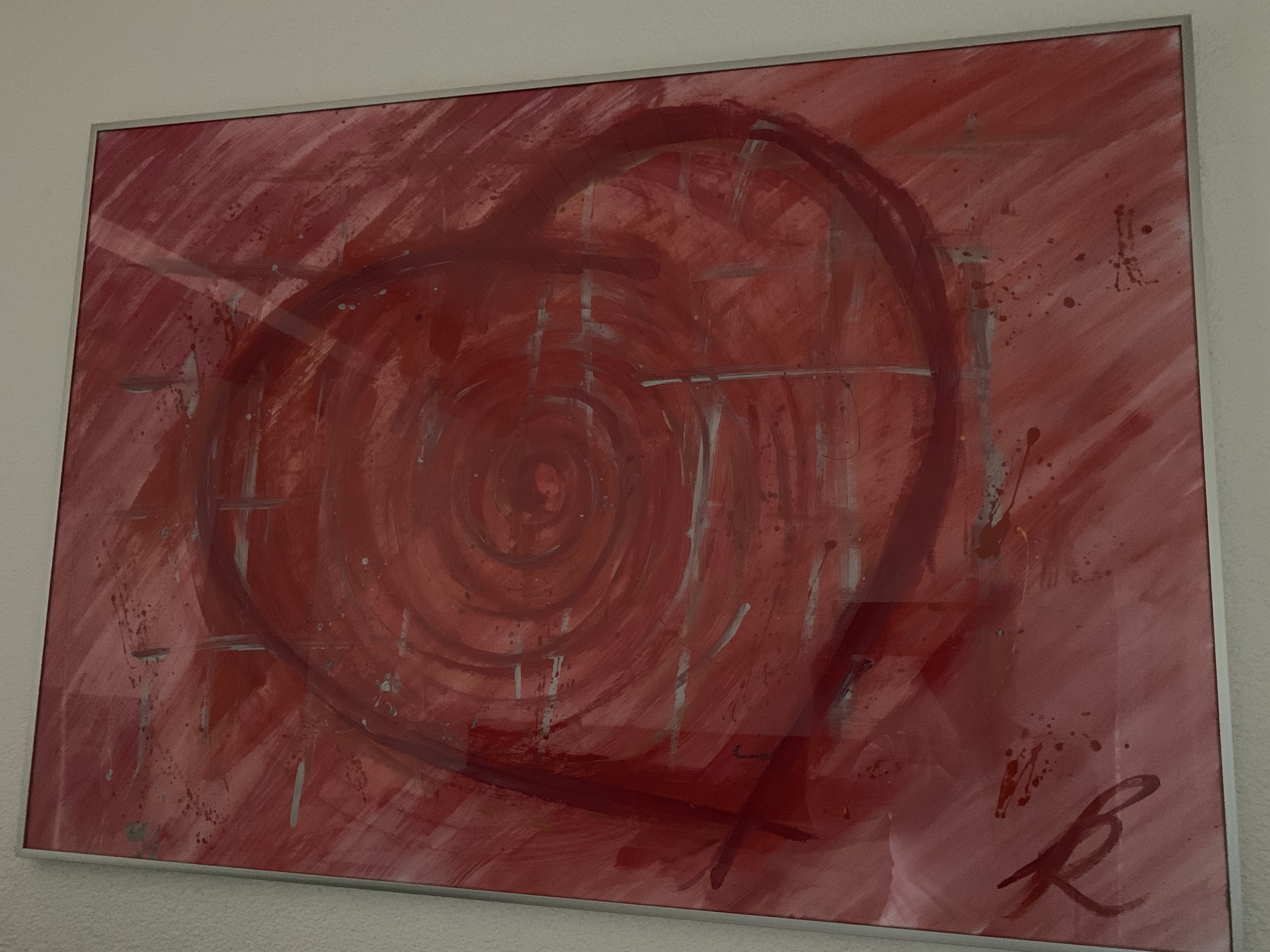
Fire element – Heart
And last but not least, here are a few famous women who also suffered from imposter syndrome:
Maya Angelou
Michelle Obama
J.K. Rowling
Oprah Winfrey
At the end of the day we need to remember – We are:
Here for a reason – in this life, in this family, in this job or business – anywhere.
Worthy – worthy of success, worthy of love and worthy of opportunities to shine.
Better than we think we are and probably know a lot more than we give ourselves credit for.
Remember this as we need to remind ourselves as often as we need to.

by jenne | General
…HHm, so as an entrepreneur you need a website, a blog, a Facebook page, an Instagram account AND a NEWSLETTER …and and and…I know, i keep bitching about it…
So this NEWSLETTER thing.. I have like 3 million newsletters in my inbox, half of which never get read – because, like, there are 3 million of them, right? And then there’s the other thing – getting spammed with SH*T everyday with all sorts of sales pitches from cosmetics, to courses, to health products or supplements, or whatever.
Before we begin, what does Wikipedia say about newsletters? Basically a newsletter is like a modern magazine containing, among other things, news and activities of a business that is sent out regularly to all its clients, members, or people who are interested in the latest ongoings.. .
Ok, what’s the point of my newsletter anyway and why would anybody else want to sign up for mine?
WELL, as newsletters can be informative, fun, inspiring, motivating, teaching and much much more and maybe not everyone has as many as I do, maybe they’re interested in what I have to say, and I might even have some profound information tips or tricks to share.
Getting back to the point of the 3 million newsletters and why I still subscribe to them – I don’t know about you, but ever so often there are some really interesting offers or articles, and often just getting a reminder that something is about to expire or disappear might just arouse my interest. And in reality, I do read a lot of them – because I love to stay informed.
As it happens, (NOTHING is coincidence, by the way) I have a friend and text coach who’s doing a free online course as part of the Somba Summer School. Some call her the newsletter midwife, …. but she goes by the name Judith “Sympatexter” Peters.
We’re already into week 4 of the course, and I’m still plodding along trying to catch up BUT, I do have an excuse. I was also facilitating my own online course in the Somba Summer School: Heartful Healing – Connect Artfully – A journey through the 5 chinese elements using art as a medium to express emotions and discover a healthy outlet for your feelings
Let’s get back to “Newsbetter” – which is what the course is all about with Judith.
“NewsBetter” was for both participants who already had a newsletter and those who wanted to start with it.
Let’s start at the very beginning.
During WEEK 1 we learned to research other newsletters – and come up with answers to the following questions:
What do I think makes up a good newsletter – and what doesn’t?
Which newsletters do I like to read and why?
Which newsletter do I not like at all? What makes me unsubscribe from a list?
It’s such a personal thing, but I love topics all around health, wellness and wellbeing – a little geeky. As I mentioned, I do read many of them and do have my favourites. I really try to only subscribe to those that interest me, but as it is in life, we sometimes go overboard with the “liking”.. This was a great moment for me to reflect on what I really read, need and want to keep being informed about. So, the clean up began. I now only have 2 million HAHA
What is the goal of my newsletter? Who do I want to inform/inspire, and how often?
The plan is:
Informative, personal, entertaining, enlightening and maybe educating
Short and sweet and sexy (maybe juicy is more appropriate)
GOOD QUESTION… Monthly…
WEEK 2 was the whole setup
Here we covered GDPR, finding a good provider, learning to setup forms and lists, attaching it to the website as well the content and design.
WEEK 3 covered content
Then there’s another issue – what do you call your newsletter? What title do you create that catches and makes it readworthy?
And then, what do you write about that captivates the reader? Interesting, informative, fun and …
So now the tech stuff was covered, where to start?
What is better suited for a blog article, and what in a newsletter?
Single newsletter or automated series?
What content do I already have that can be “re-purposed” from Facebook posts or Instagram articles?
Are there presently any hot topics on the press?i
What can I write about that doesn’t take me a year to get done, or feel like it’s a huge burden to get done?
Week 4 – THE NEWSLETTER
Thank goodness week 4 isn’t over yet, because, well, you guessed it – I didn’t get finished. Well, it is now, because it only took me like – however long – to get this written, edited and whatever…
If you want to read more on how this whole thing ended – well then, sign up here…
And you may have noticed… I like putting triple dots like next to each thing that I find 1. either important 2. worthy of mentioning 3. just because that’s me…